/How Does the Synthetic Rubber Gloves Production Line Differ from Traditional Latex Glove Lines?
How Does the Synthetic Rubber Gloves Production Line Differ from Traditional Latex Glove Lines?
Feb 27, 2026
For manufacturers and investors in the disposable glove industry, choosing the right production technology is as crucial as selecting the final glove material. While both synthetic rubber (like nitrile) and natural latex gloves share a similar dipped manufacturing principle, their production lines are engineered with distinct processes to handle the unique properties of their base materials. Understanding these differences is key to optimizing your investment for target market demands, whether it's high-volume medical exam gloves or specialized industrial-grade protection.
The first major divergence lies at the very beginning: raw material handling and compounding. A traditional latex glove production line is designed to process natural rubber latex, which requires careful stabilization and maturation. The formulation involves specific vulcanizing agents and accelerators suited for the natural polymer. In contrast, a synthetic rubber glove line, such as one for nitrile, handles pre-polymerized emulsions like Nitrile Butadiene Rubber (NBR). The compounding chemistry differs significantly, with synthetic lines often incorporating different co-agents and stabilizers to achieve the desired chemical resistance and physical properties, directly influencing the downstream glove making machine parameters.
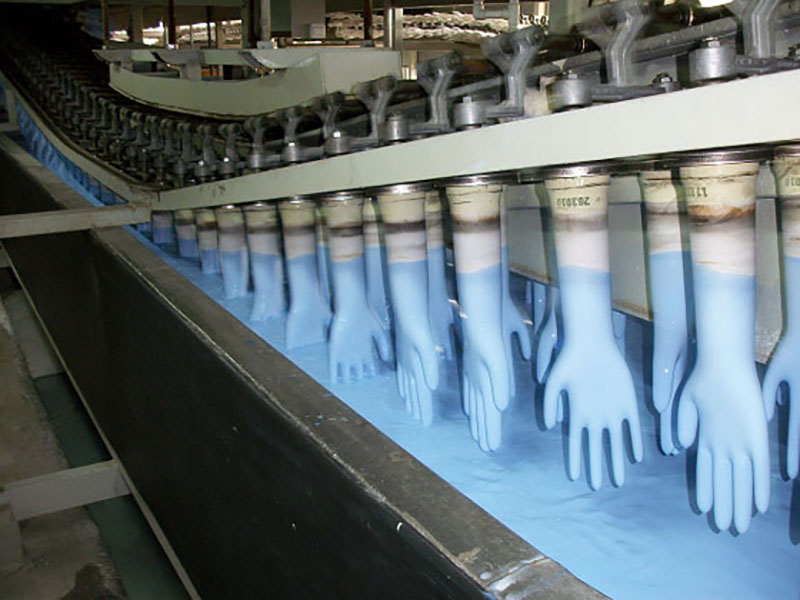
The core of the difference is most evident in the dipping and curing stages. Both lines use ceramic formers on a conveyor, but the process parameters are tailored. The automatic glove dipping machine for latex typically employs a coagulant (like calcium nitrate) dip before the latex dip to facilitate film formation. For synthetic rubber like nitrile, the compound's chemistry may require adjustments in the coagulant bath or even a different mechanism for gel deposition. The most significant technological split occurs in the curing oven. Latex gloves undergo vulcanization, where heat causes cross-linking of the natural rubber molecules. Synthetic rubber gloves, particularly nitrile, also require vulcanization but often at different temperature and time profiles. Advanced glove production equipment for nitrile might feature longer or multi-zone ovens to ensure complete curing of the synthetic polymer, impacting line speed and energy consumption.
Post-dipping processes also see variations tailored to the end product's requirements. Leaching—a washing process to remove residual chemicals and proteins—is critical and more stringent for natural latex glove manufacturing machinery due to allergen concerns. The protein removal stage is a defining step for medical-grade latex gloves. For synthetic gloves, the leaching focus shifts to removing unreacted monomers and other processing chemicals.
Furthermore, finishing steps like chlorination for donning ease or polymer coating might be integrated differently into the line based on the base material's response. The entire latex glove production line is a symphony of coordinated stations, from former cleaning to beading, stripping, and packaging, each calibrated for the specific rheology and behavior of the material being processed.
In summary, while the overarching architecture of a dipped glove line remains consistent, the devil is in the details. A synthetic rubber glove line is engineered for the consistency and chemical profile of man-made polymers, often prioritizing precision in chemical dosing and thermal curing. A traditional latex line is fine-tuned for the biological variability of natural rubber, with enhanced leaching and allergen mitigation stages. For a manufacturer, the choice dictates not just the product portfolio but the core engineering of their factory floor. Partnering with an expert who understands the intricacies of both latex glove making machines and synthetic line adaptations is essential for building a competitive and flexible operation ready to meet diverse global safety standards.
Discover a range of high-performance glove production machines meticulously engineered to meet the diverse needs of our clients. Our machinery is designed to enhance production efficiency and product quality.
Experience the future of glove machine assembly with our advanced production lines. Our assembly lines are crafted to optimize your production, ensuring seamless operation, increased output, and consistent glove quality. With customizable features and precision engineering, we offer solutions tailored to your specific requirements.
Если вы заинтересованы в нашей продукции и хотите узнать более подробную информацию, пожалуйста, оставьте сообщение здесь, мы ответим вам, как только сможем.